A Tool for Navigating the Double Empathy Problem in Relational Work
Many relational conflicts aren’t caused by lack of care, empathy, or effort - but by the pressure that individual differences place on connection when no shared framework exists.
Traditional relational models focus on behavior, regulation, or communication skills alone. But connection often breaks down somewhere else - when differences in processing, pacing, and meaning-making are misunderstood, and both people begin to feel misread, pressured, or responsible for holding the relationship together.
This deck makes the those invisible dynamics visible:
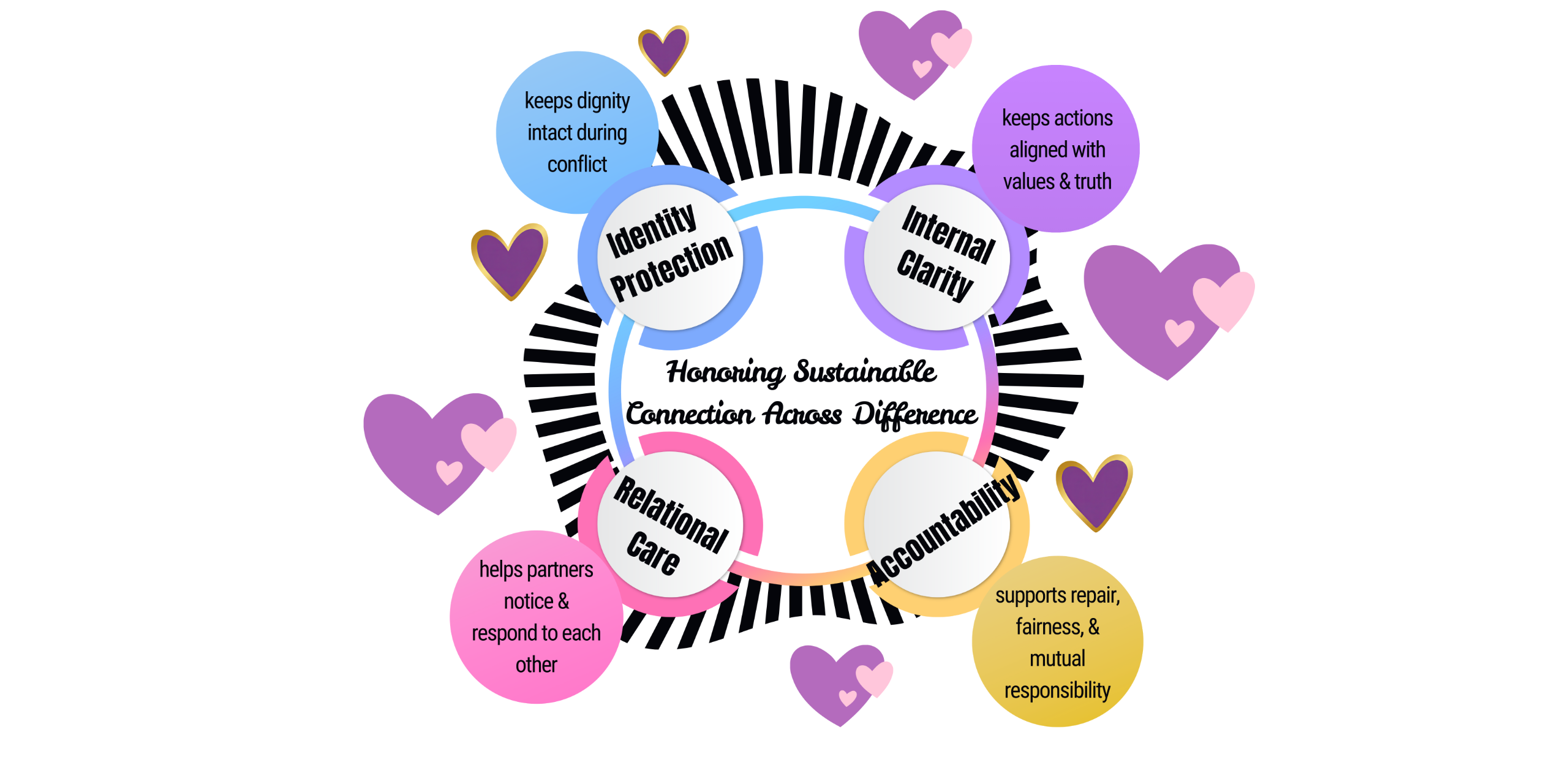
Sustainable connection requires holding all four - internal clarity, relational care, identity protection, and accountability - not perfectly, but in ongoing balance between people.
This makes the deck especially appropriate for adults who have been harmed by compliance-based or deficit-framed approaches.

Introducing a neurodiversity-affirming framework for engaging across difference with clarity, consent, shared accountability, and mutual respect.
The Relational Integrity Card Deck was created to support both partners in navigating moments where different neurotypes, processing styles, or relational rhythms can be interpreted as indifference, rejection, or pressure. Rather than asking anyone to mask, over-accommodate, or force sameness, the deck:
-
does not require shared emotional experience
-
does not privilege one nervous system, pace, or pathway
-
supports parallel coherence rather than forced synchrony
-
considers needs related to internal clarity, pace differences, engagement regulation, stimulation thresholds, expression styles, and repair timing
-
helps partners remain authentic while staying accountable to the relationship
The goal is not perfect agreement or constant harmony. It is connection that can hold difference without shame, pressure, or self erasure.
Relational Integrity Cards Professional PDF License
$149
Top features
- PDF of card deck (240-cards, each card sized 2 x 3.5 inches) in the format of 24 pages, double-sided) for download and printing
-
Professional PDF license (for reprinting or replacements) - license grants permission to use with clients

Personal Use PDF
$69
Top features
-
Digital PDF card deck (240 cards)
-
Print-ready layout: 24 pages, double-sided
-
Card size: 2 x 3.5 inches (standard playing-card size)
-
Designed for home or professional printing
-
Personal-use only (non-transferable)
For Individuals & Couples (Personal Use):
This deck is also available for personal use at home.
Relational Integrity Cards can support:
-
individuals and couples navigating communication differences
-
neurodivergent relationships
-
people wanting structure for repair and boundaries
-
individuals working on relational patterns
No clinical training is required to use the deck. It is designed to:
-
slow conversations
-
support consent and pacing
-
reduce pressure to perform emotional responses
-
help both people stay grounded while navigating difference
The personal use version is:
-
not therapy or mental health treatment
-
best used during calm or reflective moments, not escalation

Email stacey@neurodivergentworkbookforclinicians.com for more information.
The Problem:
When people with different neurotypes, processing styles, or relational rhythms misread one another despite good intentions, difference can be interpreted as indifference, rejection, or pressure - leaving both people feeling unseen, defensive, or unsure how to repair. Over time, these moments can create shame, distance, and integrity-threatening pressure to perform connection rather than engage authentically. Conflict arises not because either person lacks skill or care, but because each is trying to connect through different pathways at the same time.
Relational Integrity Cards
A neurodiversity-affirming skills card deck for navigating relationships with authenticity, accountability, and care.
Designed to support connection without self-abandonment or pressure.
This card deck is not about social conformity, emotional performance, or “better behavior.”
Within couples work, this card deck does not require emotional sameness, shared processing speed, or identical expressions of care. Instead, this deck centers coherence, integrity, and relational ethics, helping people:
-
access clarity, values, and meaning in real time
-
stay grounded in their own experience while engaging honestly across difference
-
recognize what supports - or limits - connection in a given moment
-
hold mutual respect without forcing agreement or resolution
-
allow connection without self-erasure
-
strengthen compassion without over-identification
-
practice accountability without pressure
-
engage responsibly across difference, power, and constraint
Grounded in neurodiversity-affirming, trauma-informed, and relational practice, the Relational Integrity Cards are designed for use in individual and couples therapy, coaching, education, and reflective personal work.
A key distinction this deck makes (and why it matters)
This deck addresses two different relational challenges, which are often confused in traditional therapy models:
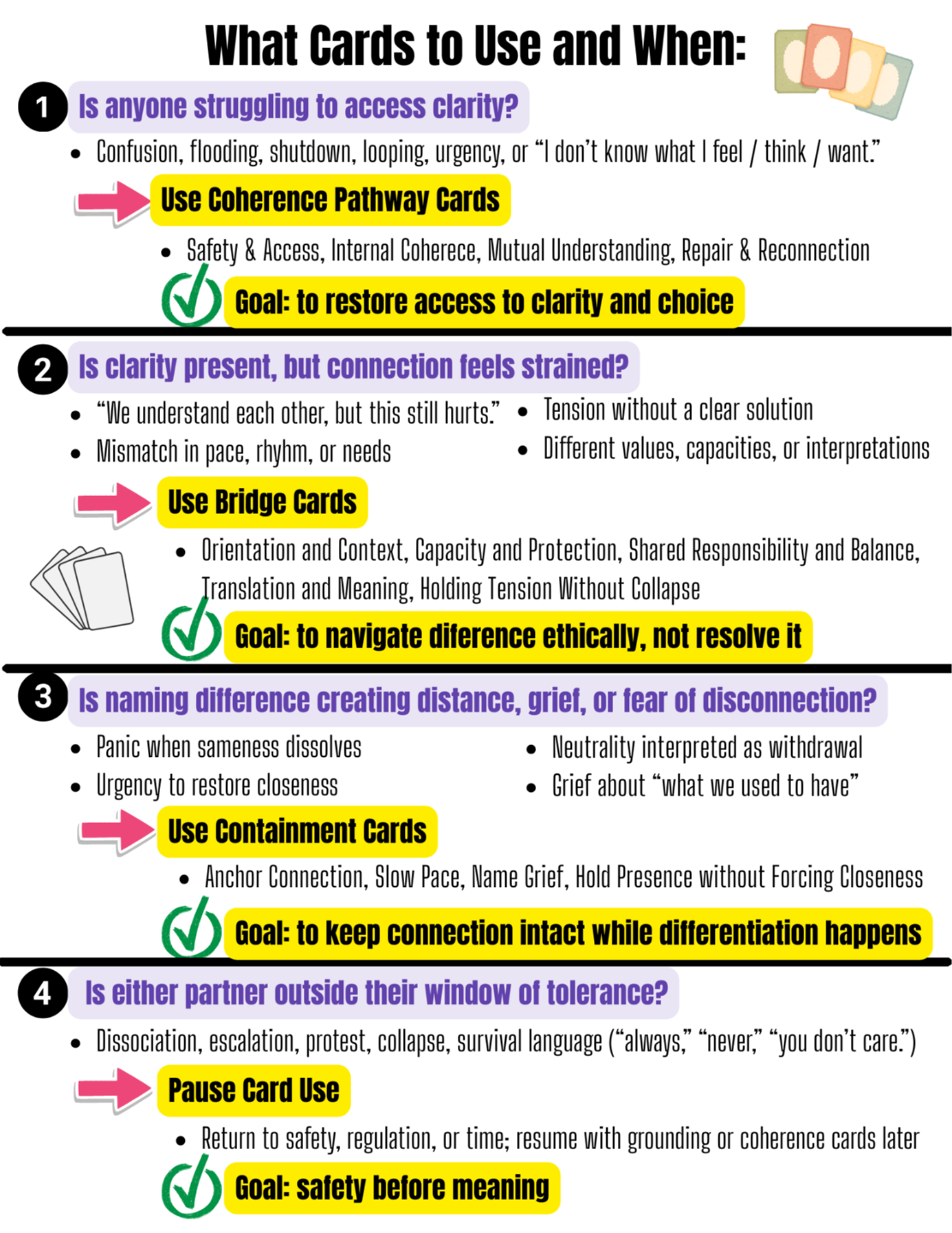
1. Restoring access to coherence
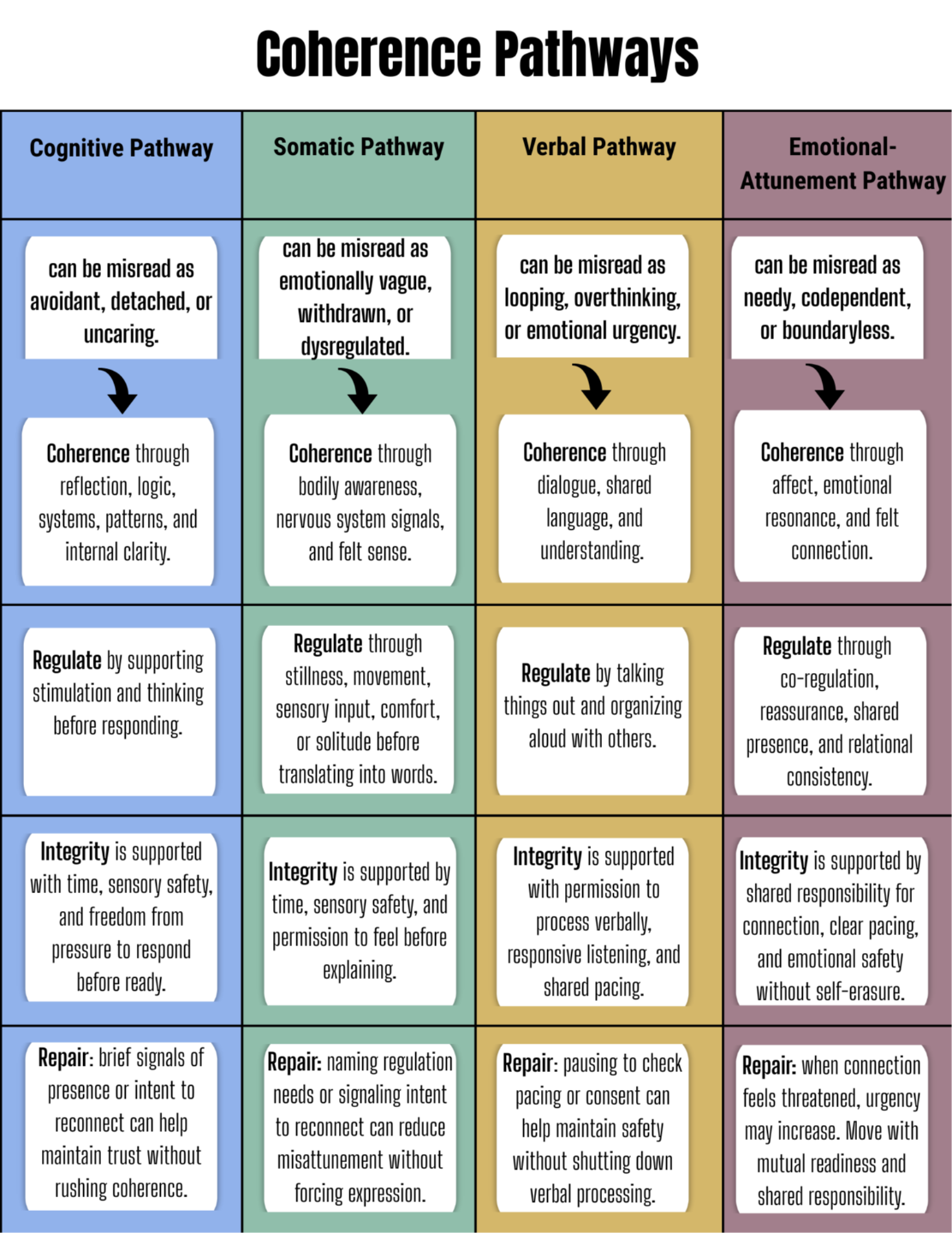
People access coherence in relationship through different pathways. These pathways differ in how meaning forms and where attention naturally orients.
Some difficulties arise because a person lacks access to clarity, emotional truth, values, or choice in the moment.
Coherence Pathway Cards support this.
An important clarification about coherence pathways
The coherence pathways described in this deck do not represent deficits, attachment failures, or mental health pathology. Each pathway engages relationship in a different way. None is more healthy, caring, or relational than another. Access is shaped by safety, context, power, and capacity. It may expand, contract, or remain stable depending on the situation.
Challenges arise not because a pathway is “lacking,” but because environments, relationships, or systems demand access through pathways that may be unavailable, unsafe, or overextended in that moment.
This deck supports ethical engagement within current capacity, rather than framing difference as something to be corrected, treated, or overcome.
2. Navigating difference under constraint
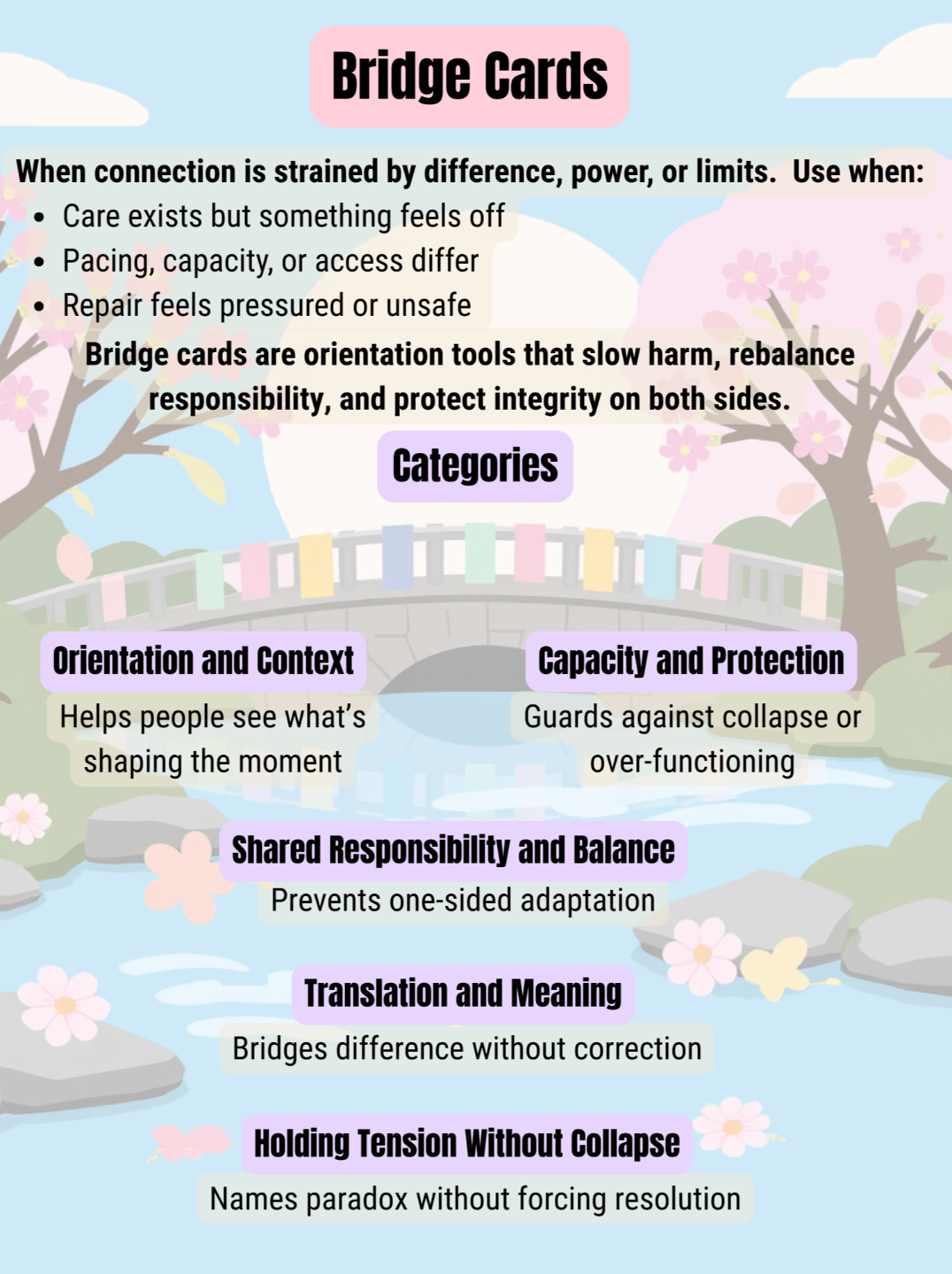
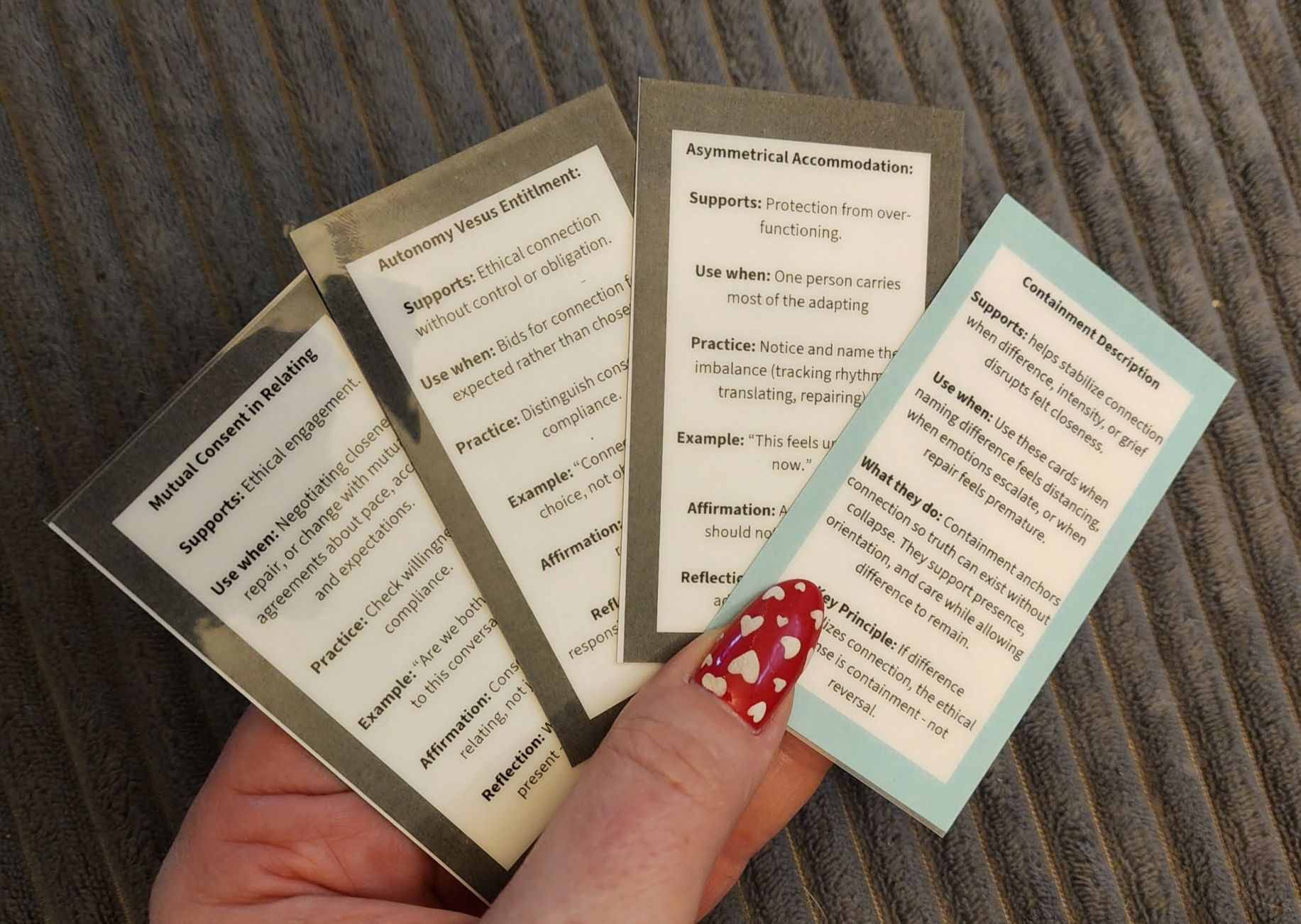
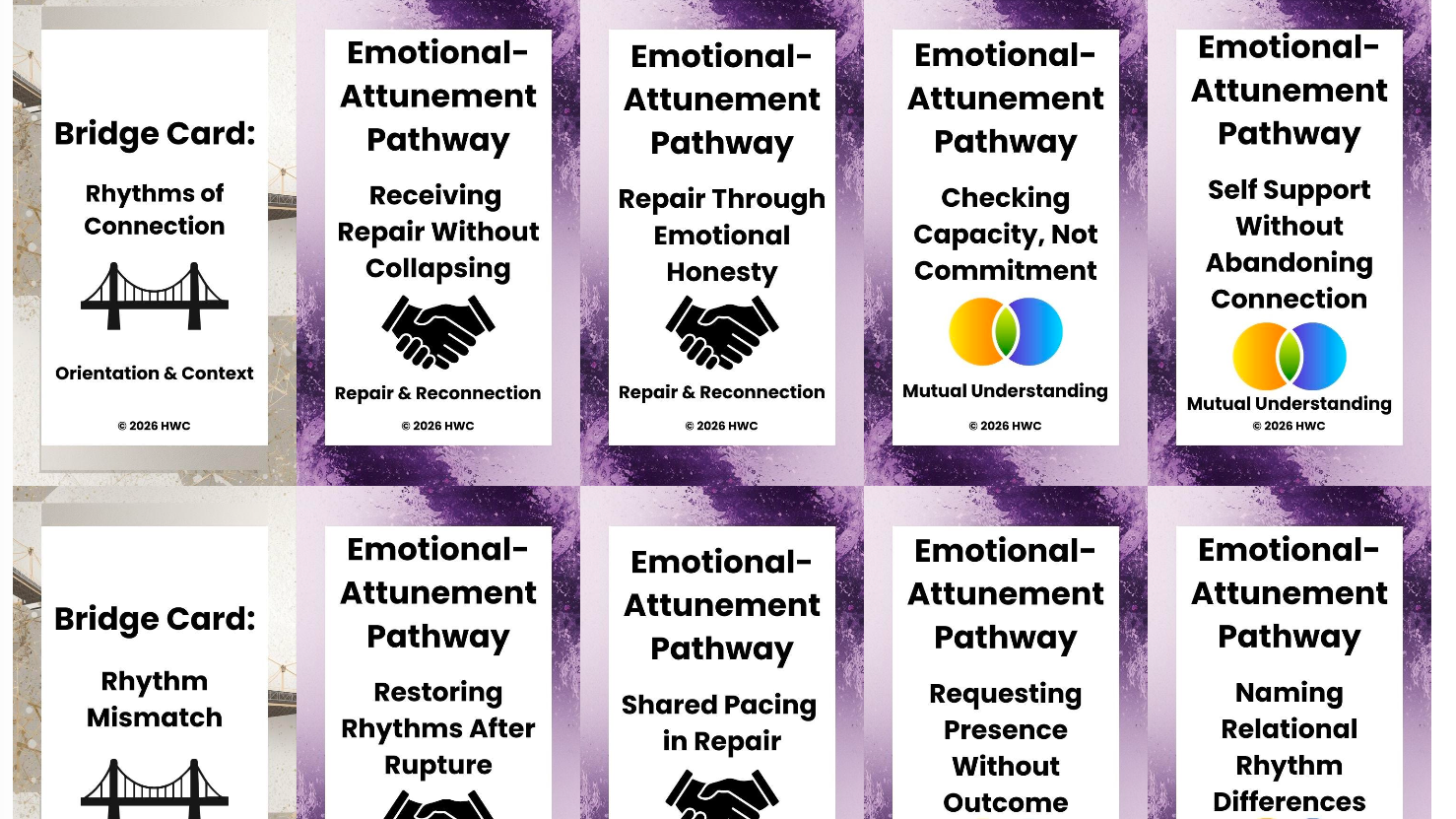
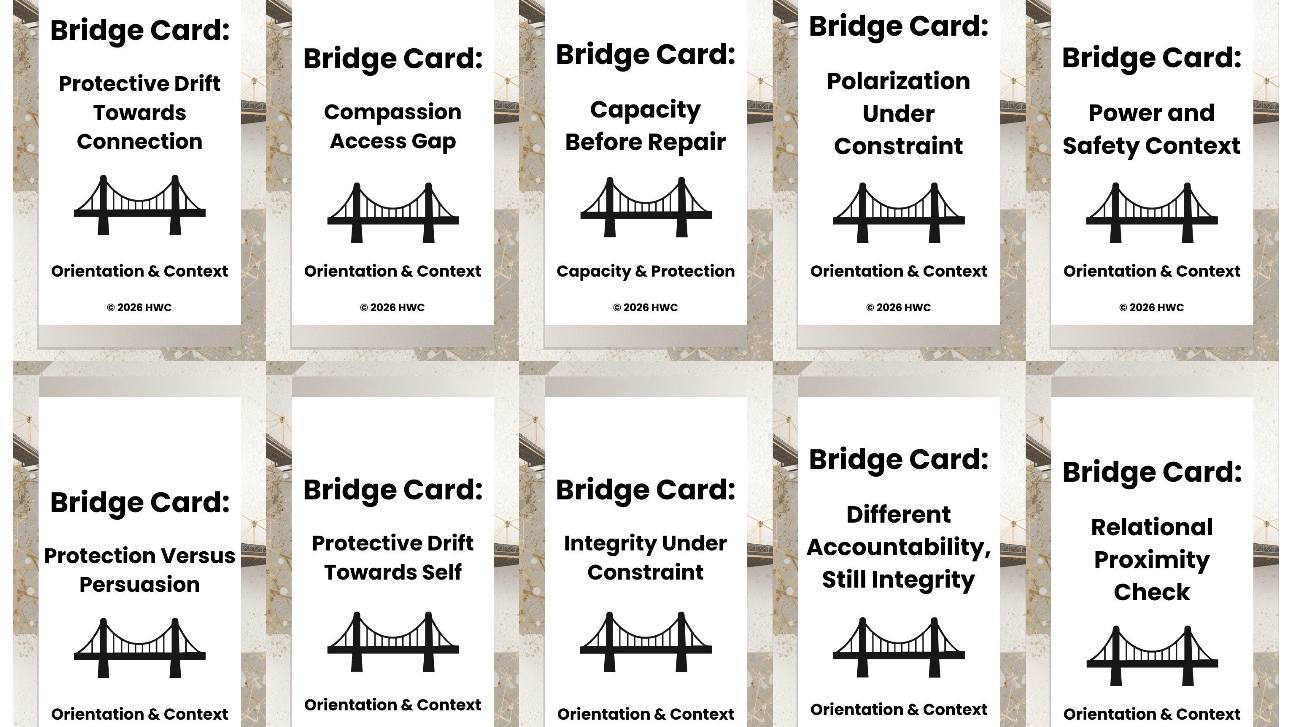
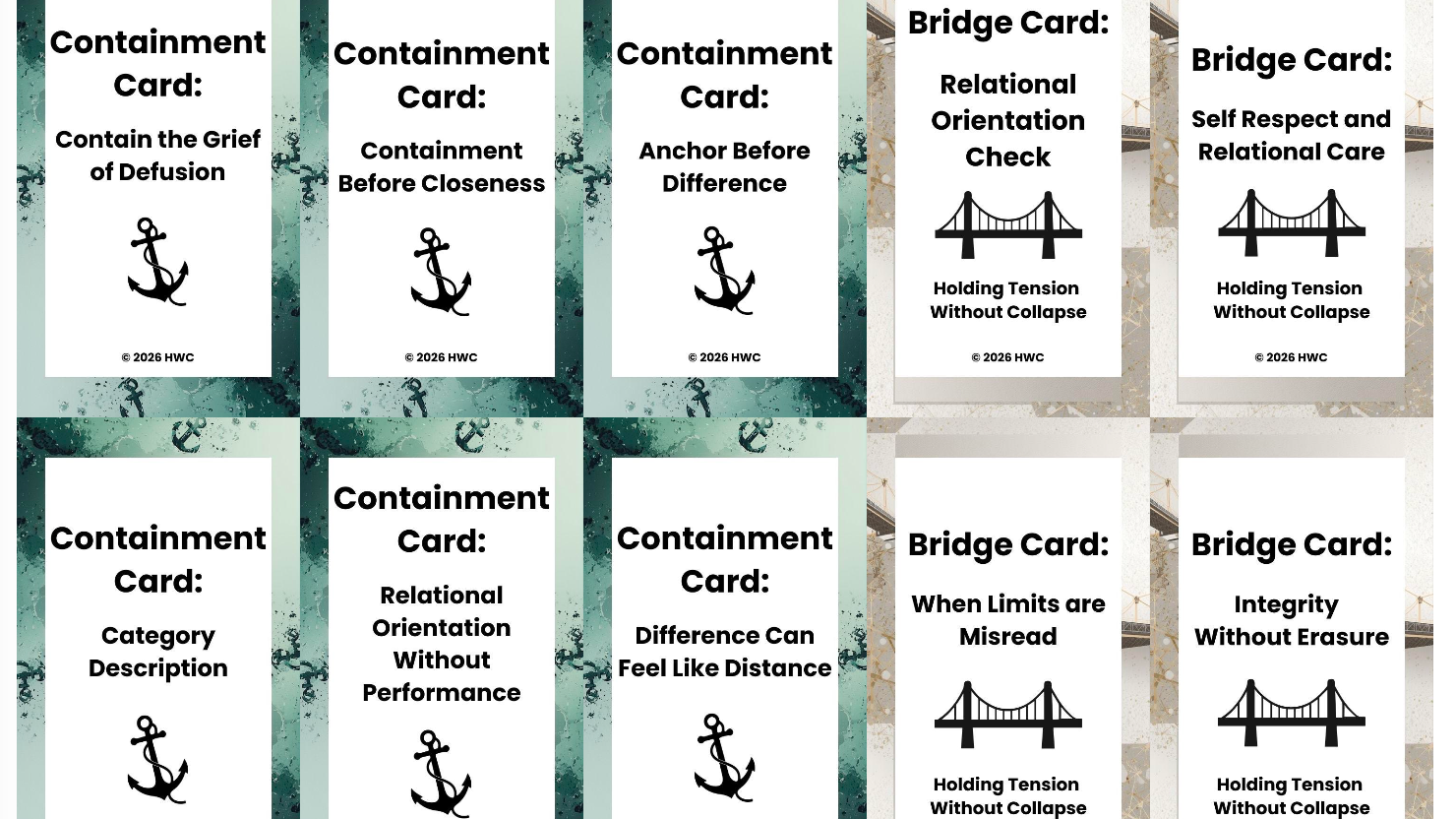
Other difficulties arise from mismatch. Bridge Cards support this.
They help people navigate tension, polarity, and difference through mutual respect and compassion - without requiring emotional sameness, resolution, or self-erasure. In this framework, compassion does not require full understanding or shared experience. It refers to an affective stance of warmth, goodwill, and respect for autonomy, even when perspectives differ.
Bridge cards protect integrity when access alone doesn’t create harmony. Bridge cards help prevent:
-
pathologizing difference
-
moralizing preferences
-
withdrawing from connection or overextending to preserve it
-
one-sided adaptation without consent
How this deck is different from traditional therapy tools
Unlike many interpersonal skills frameworks, this deck:
Distinguishes regulation from coherence
Calm behavior is not treated as the goal. Alignment, authenticity, and ethical engagement are.
Centers relational integrity, not compliance
Skills are framed as choices, not obligations.
Honors multiple pathways to connection
People connect through different rhythms and meaning-making styles. No pathway is privileged or treated as more “healthy.”
Explicitly addresses power, safety, and non-inclusive environments
Including considerations of when not to engage, disclose, repair, or bridge.
Prevents misuse
With built-in safeguards against:
-
over-accommodation
-
forced unmasking
-
pathologizing difference
-
relational pressure disguised as “growth”

What outcomes this deck supports
This deck does not promise perfect harmony or constant empathy.
It supports something more sustainable:
-
increased self-trust and internal clarity
-
reduced blame around mismatch
-
ethical boundaries without withdrawal or aggression
-
accountability without collapse or coercion
-
connection approached through consent, not urgency
The goal is not fixing people or relationships - but engaging with integrity when difference is real.
The problems this deck addresses
Many neurodivergent people are taught “social skills” that prioritize:
-
appearing calm
-
complying with norms
-
suppressing difference
-
masking to avoid conflict
While these strategies may increase short-term acceptance, they often lead to:
-
burnout and chronic exhaustion
-
identity confusion or fragmentation
-
shame around natural regulation and processing needs
-
relational resentment, rupture, or collapse
Traditional therapy tools may unintentionally reinforce this by focusing on behavioral regulation without attending to coherence, consent, power, or context.
Relational Integrity Cards respond directly to this gap.
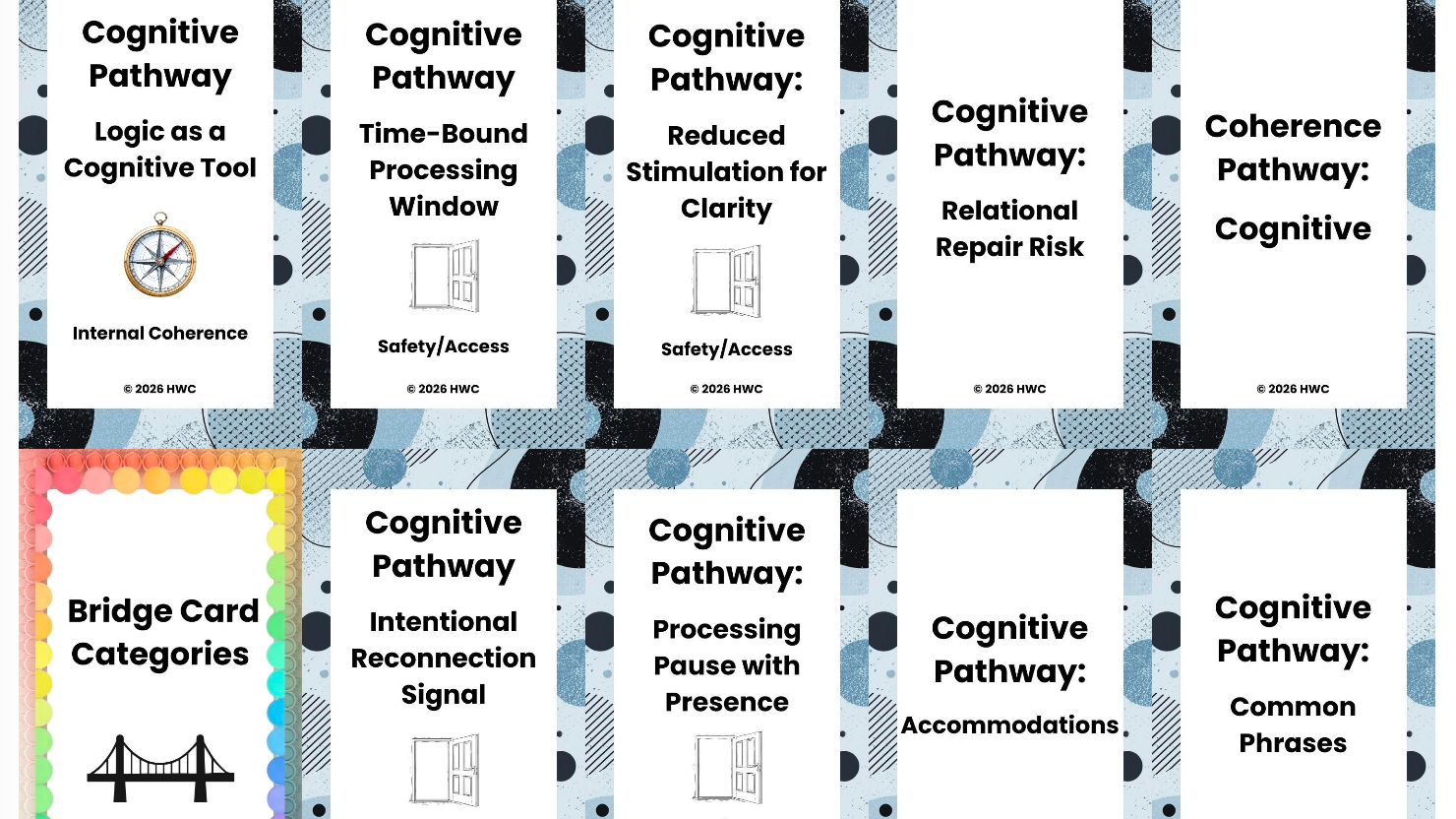
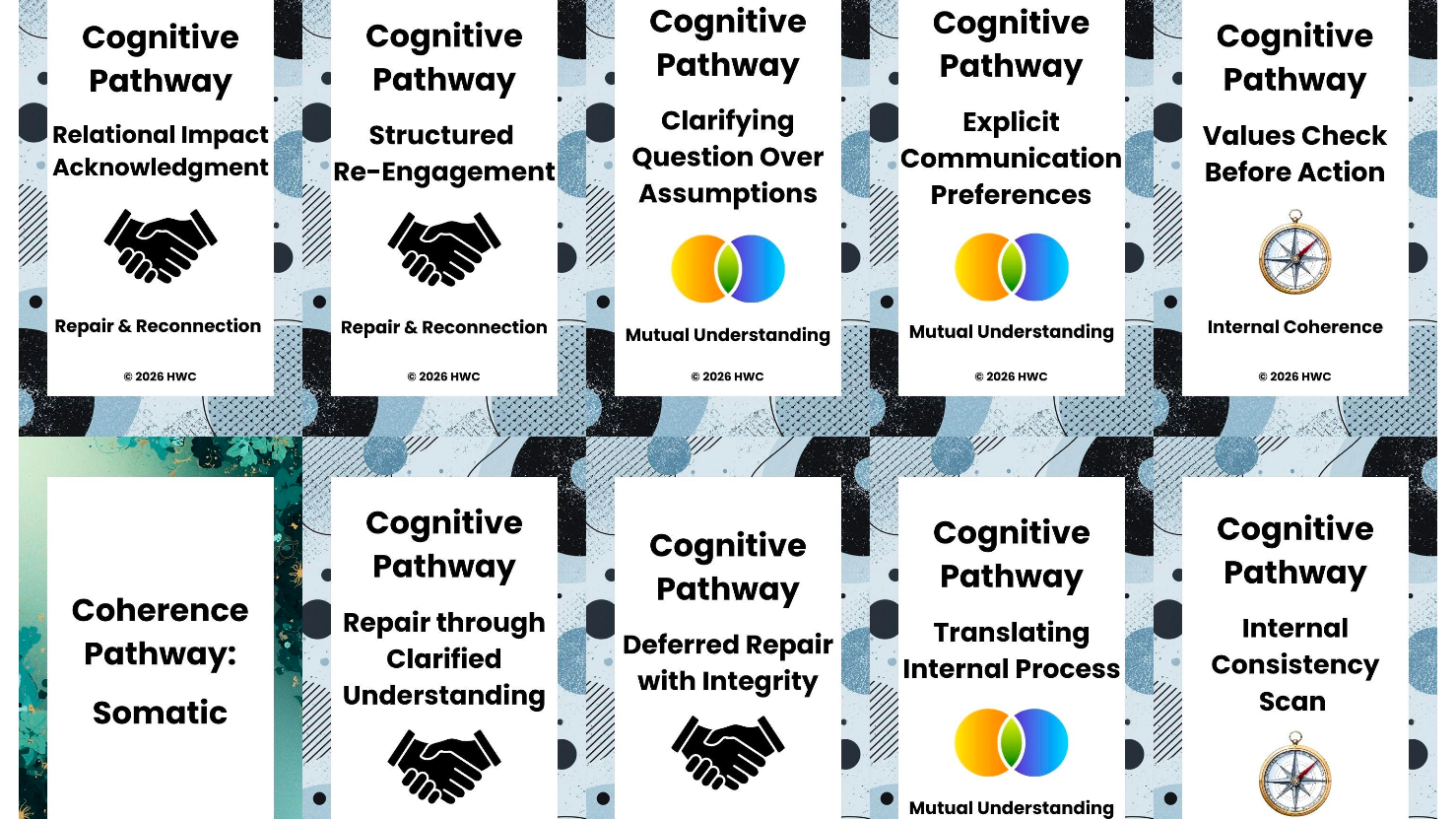
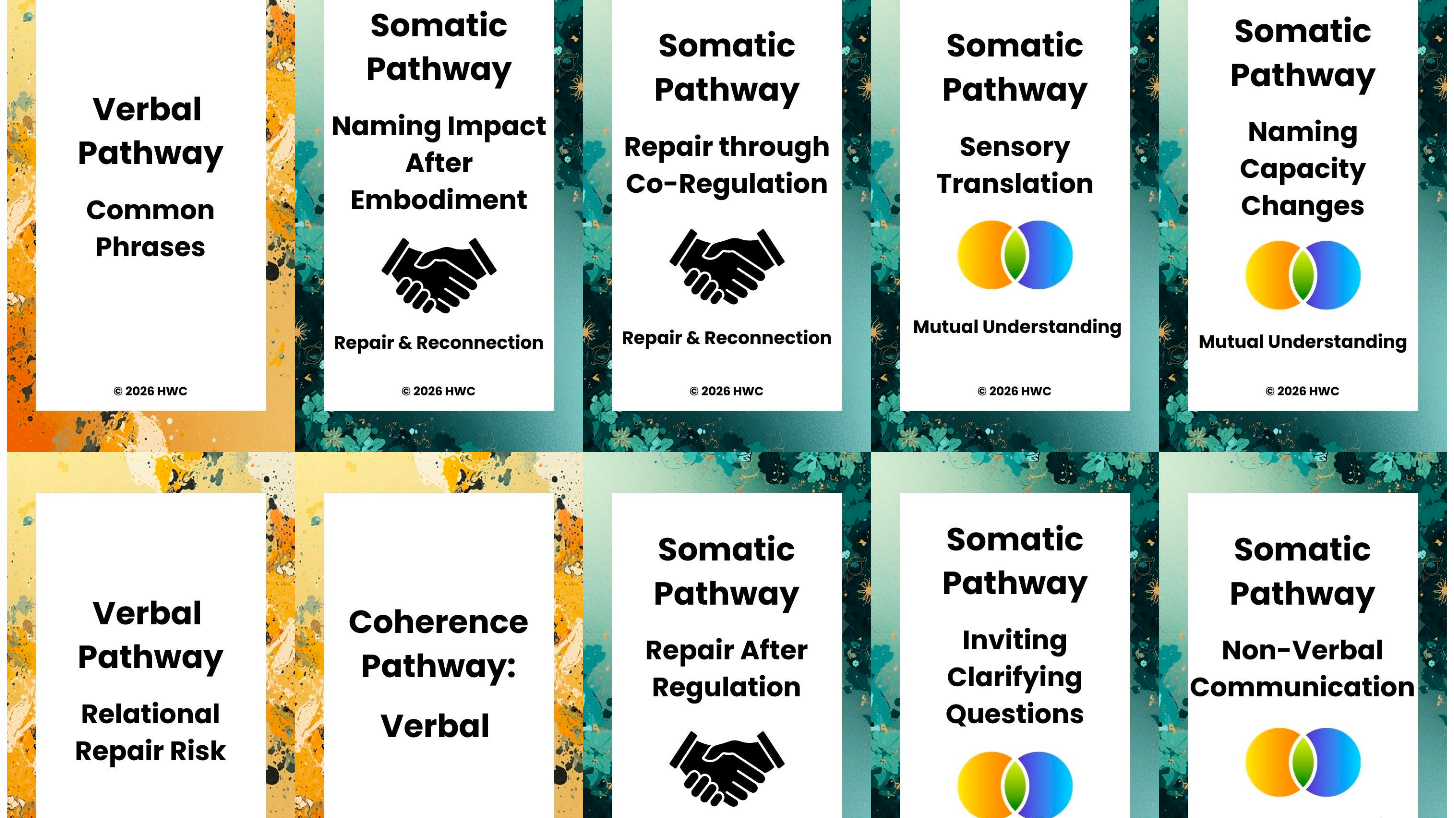
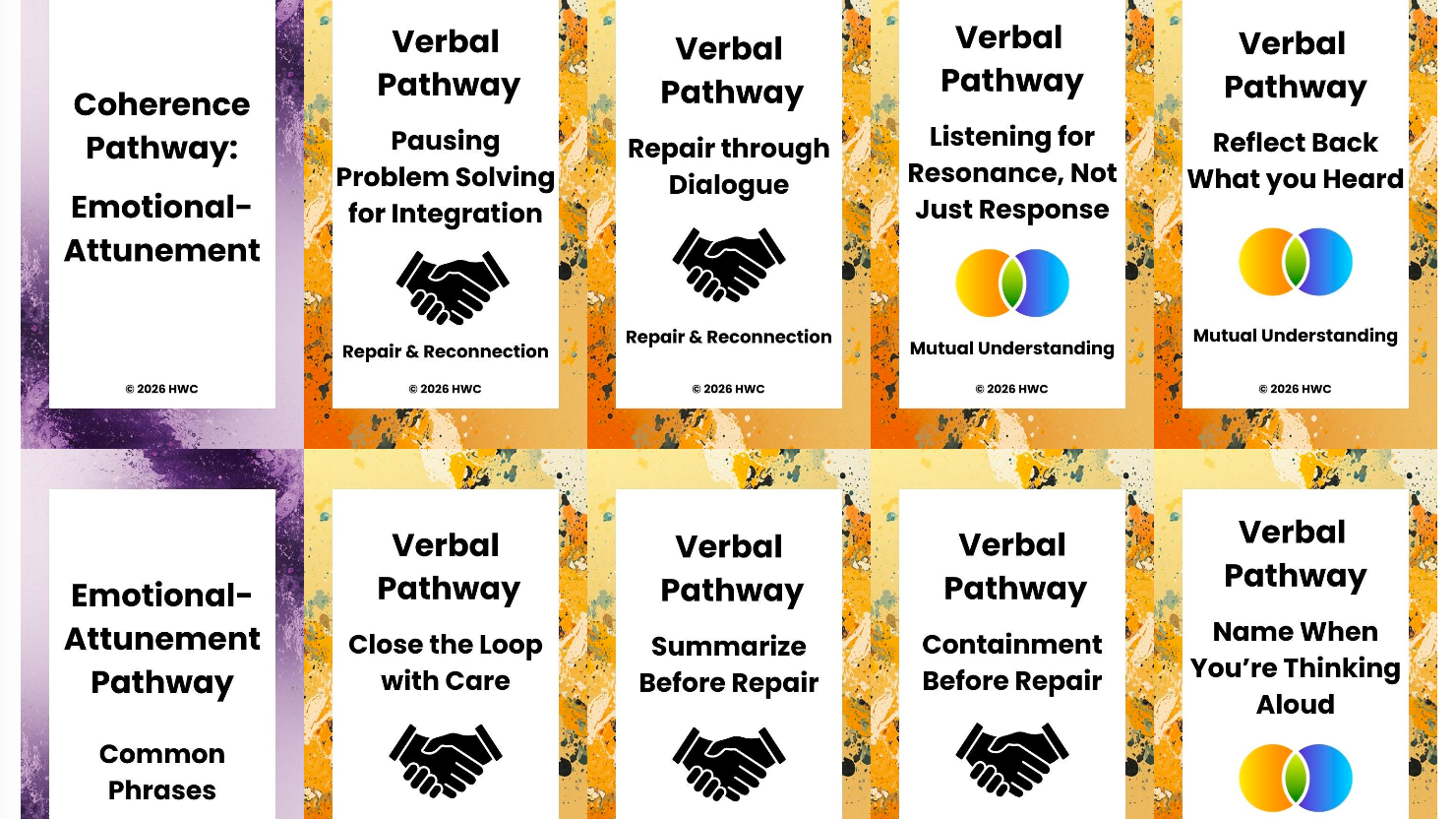
How cards are used
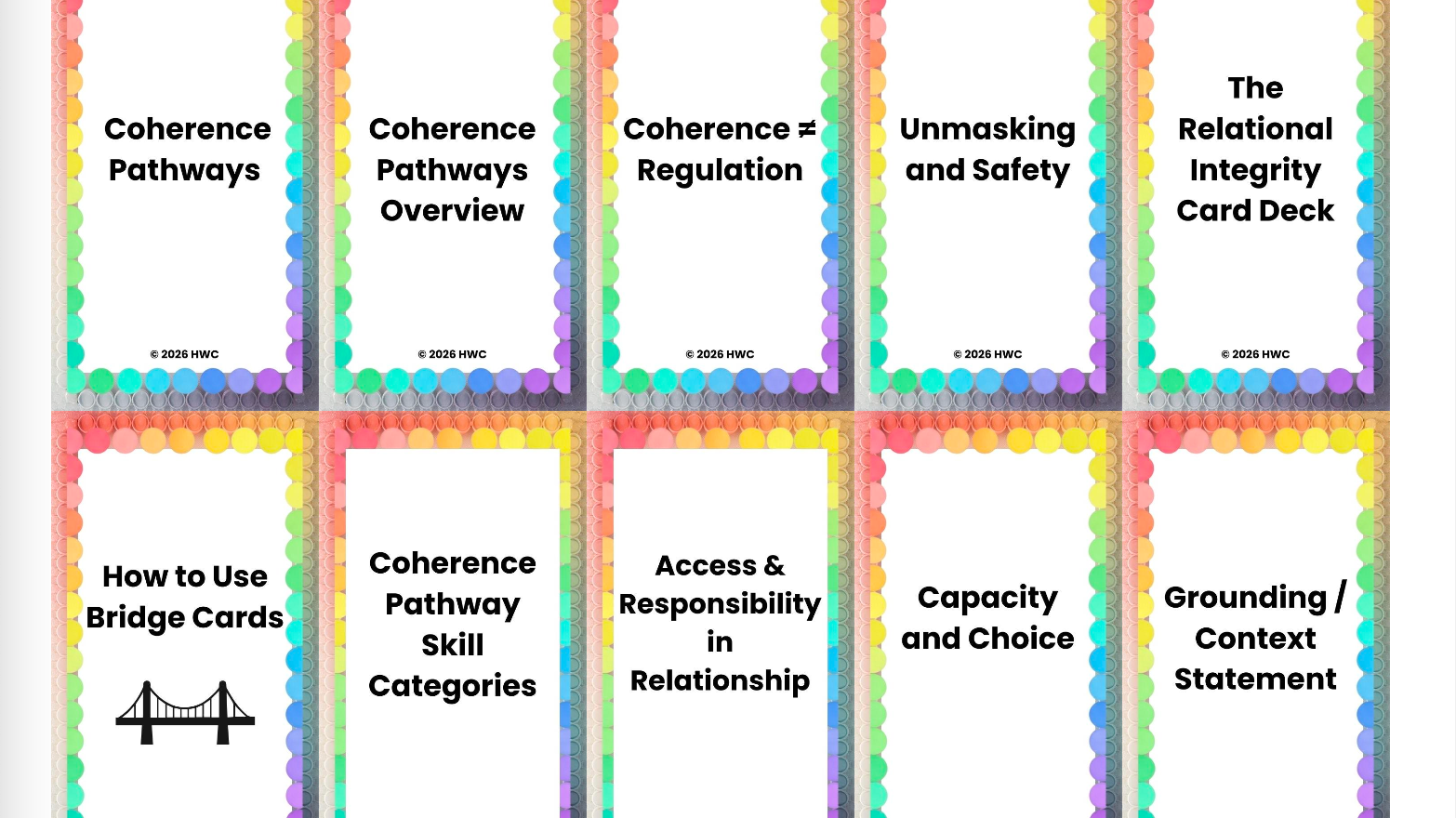
The deck can be used flexibly, including:
-
in individual therapy (reflection, processing, skills support)
-
in couples or relationship work (translation, pacing, repair)
-
in group therapy or psychoeducation
-
as a therapist-guided intervention or client-led exploration
-
for preparation before or reflection after difficult interactions
-
for navigating work, family, community, or institutional contexts
Clients do not need to identify a “primary style,” follow a sequence, or use the entire deck.
Cards are selected by resonance, context, and current capacity.
Who this deck may be helpful for
This deck may be especially useful for:
-
autistic adults
-
ADHD adults
-
neurodivergent people in mixed-neurotype relationships
-
clients with a history of masking, burnout, or over-accommodation
-
clients struggling with relational boundaries or self-abandonment
-
therapists seeking neurodiversity-affirming interpersonal tools
-
clinicians working in trauma-informed, relational, or identity-affirming frameworks
What this deck does not do
-
It does not diagnose or assess mental health conditions
-
It does not treat relational differences as deficits
-
It does not rank pathways by health or maturity
-
It does not require disclosure, emotional performance, or unmasking
-
It does not assume that more emotional expression equals better integration
Adaptation, withdrawal, and protection are treated as contextual strategies, not failures.
Core ethic
At the heart of this deck is a simple principle:
Relational skillfulness is not about performing acceptability. It's about engaging with integrity - honoring both self and others.
Disclaimer: Relational Integrity Cards are an educational and reflective tool. They are not therapy, clinical supervision, diagnosis, or a substitute for mental health care. Use of this deck is intended to support relational awareness, coherence, and ethical engagement. Professionals are responsible for applying these materials within the scope of their own training, license, and ethics.