Neurodivergent Love: Reducing Conflict & Rebuilding Intimacy Across Difference
A 4-Week Live Training for Clinicians
Next LIVE ND LOVE Class Series dates: Saturdays, 1030 am - noon CST via Zoom, on July 18, July 25, Aug 1, and Aug 8th
6 AASECT continuing education credits included for live classes
Learn how to reduce misattunement, support repair, and build intimacy in neurodivergent relationships—without pathologizing difference or reinforcing shame.
Early bird pricing
$247
Core Features
-
4-part series (includes four 1.5 hour class sessions)
- Replay available
- 6 AASECT Continuing Education Credit
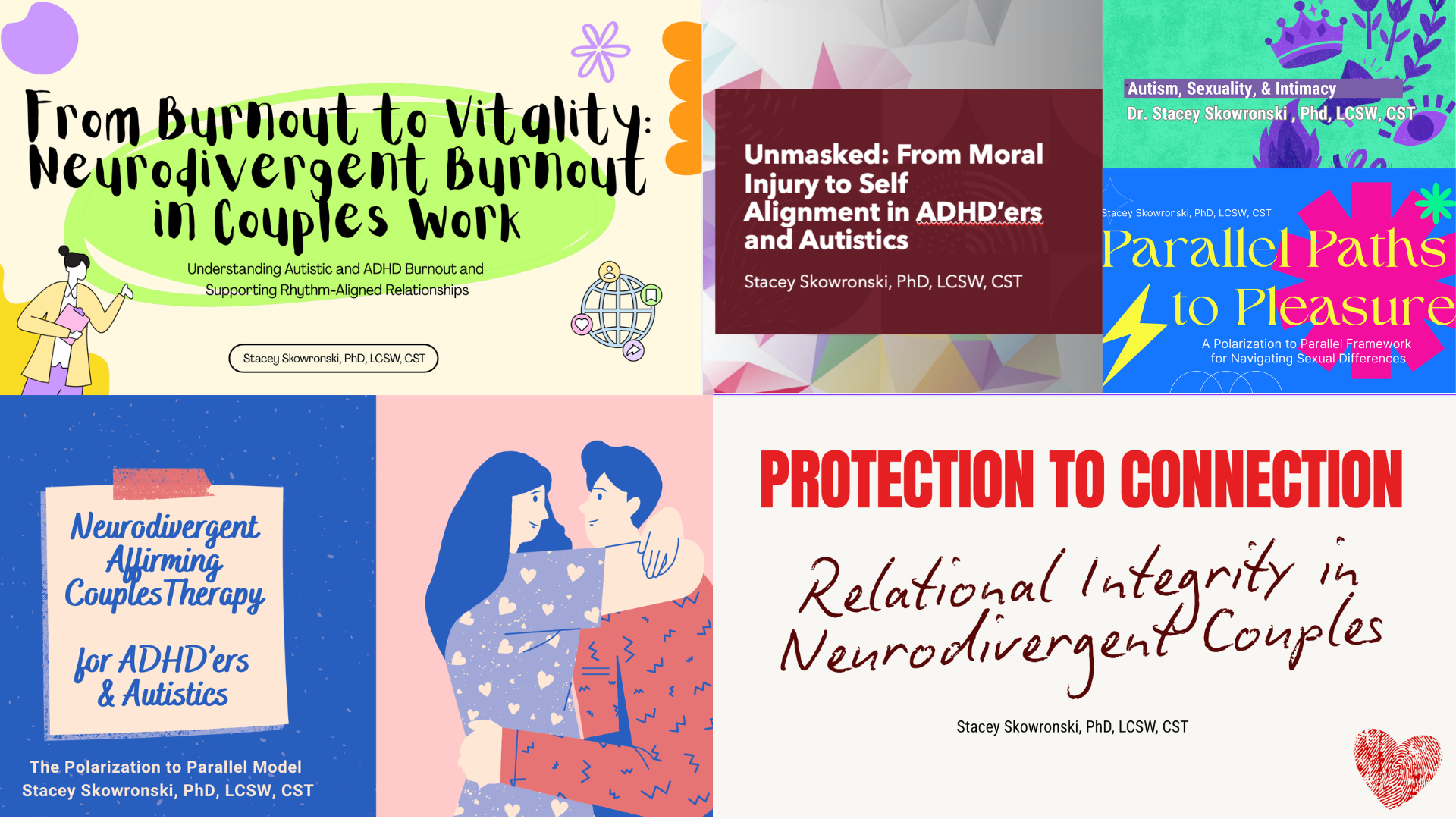
The Problem. Many couples therapy models assume:
✅ shared emotional pacing
✅ verbal processing as the primary mode
✅ conflict resolution through immediate engagement
But for neurodivergent couples, these assumptions can lead to:
👉 chronic misattunement
👉 shame cycles
👉 misinterpretation of regulation differences as resistance or avoidance
Clinicians are left trying to:
✅ adapt models that don't fully fit
✅ support clients without reinforcing internalized ableism
✅ navigate accountability without triggering shame collapse
This training offers a different approach:
This 4-week training introduces a neurodivergent-affirming framework for understanding:
✅ how difference - not dysfunction - drives conflict
✅ why misinterpretation leads to disconnection
✅ how to support both self-protection and connection in the same relational space
✅ how to facilitate repair without reinforcing shame or compliance-based models
Week 1: Neurodivergent Burnout in Couples
✅ How masking, cognitive load, and chronic misattunement impact relational capacity
✅ Why “effort” is often misread when regulation is compromised
✅ Clinical strategies for reducing overwhelm and restoring capacity
Week 2: Shame and Polarization
(The Polarization to Parallel Model)
✅ The role of shame in disconnection and defensive cycles
✅ How polarization develops across neurotype differences
✅ Differentiating trauma responses from neurodivergent self-advocacy
Week 3: Intimacy Across Difference
✅ Neurodivergent considerations for intimacy
✅ Expanding beyond neurotypical norms of connection
✅ Supporting multiple pathways to emotional and somatic intimacy
Week 4: From Protection to Connection
(The Relational Integrity Lens)
✅ A structured approach to repair that reduces shame and increases safety
✅ Supporting accountability without identity threat
✅ Clinical interventions for real-time misattunement and reconnection
This training integrates:
✅ Neurodiversity paradigm (difference ≠ deficit)
✅ Deconstruction of Capitalism and neurotypical relationship norms
✅ Capacity-demand burnout models
✅ Polarity Management, shame resilience, and trauma informed approaches
✅ Relational integrity
(inspired by relational cultural theory, polyvagal theory, consent + anti-coercion frameworks, differentiation + family systems, metallization & epistemic humility)
Core Clinical Framework:
Clinicians will learn how to support four key domains of relational integrity:
✅ identity protection
(Can I be myself without being corrected or diminished?)
✅ internal coherence
(Can I stay aligned with my own pacing, clarity, and internal experience?)
✅ relational care
(Do I feel seen, responded to, and emotionally registered?)
✅ accountability (without shame collapse)
(Can we repair impact in a way that feels safe and fair?)
WHO THIS IS FOR
This framework helps you:
✅ Therapists working with neurodivergent or mixed-neurotype couples
✅ AASECT certification candidates (6 CE credits available when taking live)
✅ Clinicians seeking alternatives to deficit-based or compliance-driven models
✅ Providers wanting to integrate intimacy, regulation, and relational repair
What makes this different:
✅ Neurodivergent affirming, not pathology-based
✅ Integrates multiple evidence-informed frameworks
✅ Focuses on translation across difference, not forcing similarity
✅ Balances accountability and compassion
✅ Provides practical, clinically applicable tools
Logistics:
📅 Dates: the following Saturdays - July 18th, 25th, Aug 1st, Aug 8th
⏰ Time: 10:30 am - 12:00 pm CST
📍 Live online (replay available)
🎓 6 AASECT credits with live class
Investment:
-
Early bird: $247
-
If you’ve already taken part of this series, I’ll apply your previous payments toward the full training.
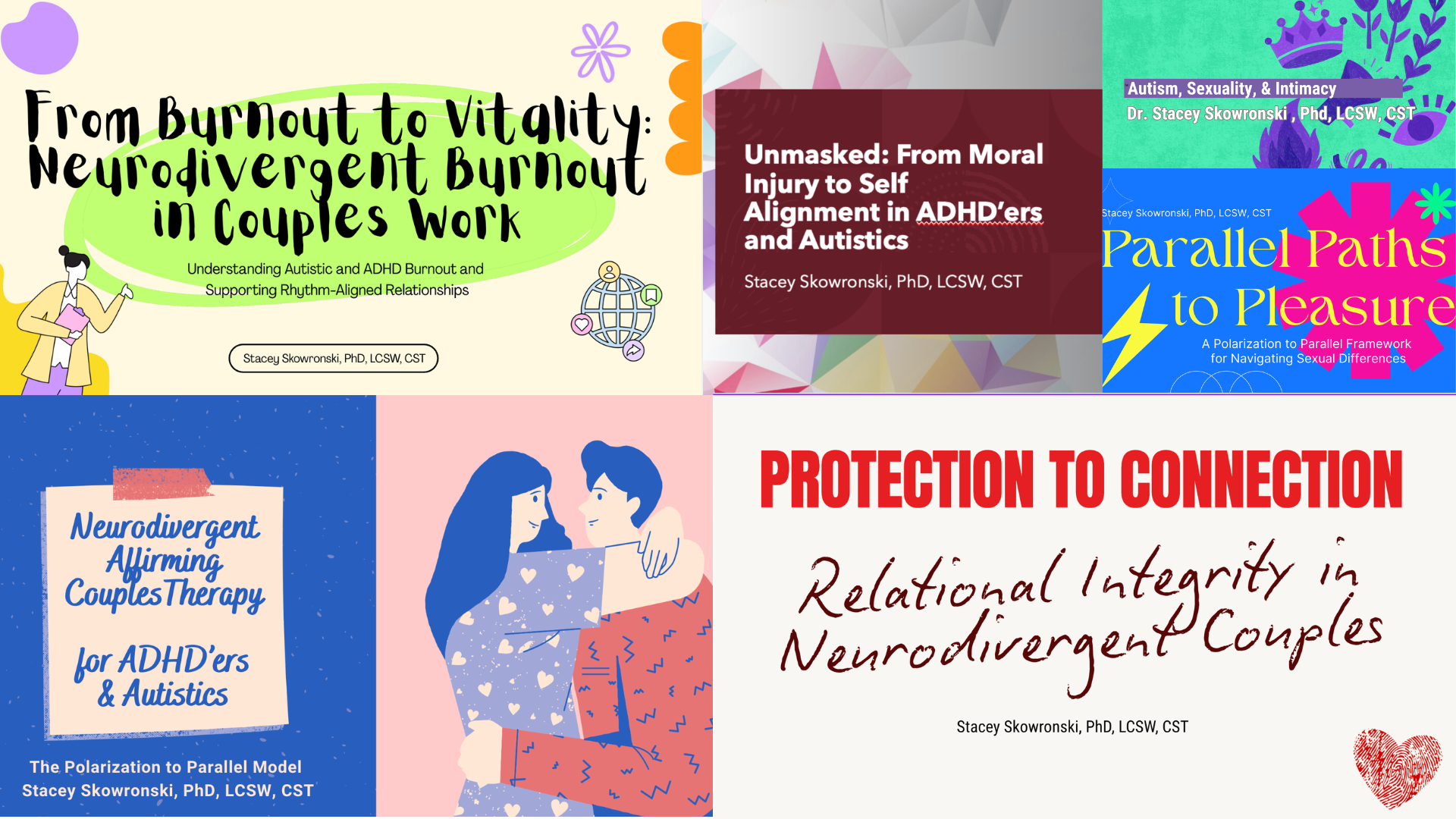
This series integrates the following trainings:
Neurodivergent relationships don’t fail because people aren’t trying.
They struggle when difference is misread - and repair doesn’t feel safe.
This training offers a framework to change that.
A Sneak Peak of What's Inside:
Couples Tools and Reflection Resources:
-
✅ Burnout Support and Prevention Checklist - a structured resource to reduce overwhelm, support regulation, and build sustainable systems for daily functioning, communication, and relational support.
-
✅ Personal Strengths Resource Inventory - a visual tool to help individuals recognize and name their strengths, shifting from a deficit-based narrative to an affirming understanding of how they think, connect, and engage.
-
✅ Deconstructing Structural Pressures Couples Reflection Tool (9-pages) - a guided worksheet to help couples identify external stressors, understand relational patterns, and create a practical Relationship Redesign Plan.
-
✅ Organizational Resources Checklist - a systems-focused visual to identify environmental supports that reduce burnout and improve executive functioning, communication, and daily structure.
Assessment and Mapping Tools:
-
✅ Polarities Assessment - Identify differences in regulation, access, and expression that shape connection.
-
✅ Trait Polarities (6-pages) - Clear definitions and examples for assessment and intervention.
-
✅ Fillable Clinician’s Checklist - track and organize relational patterns and polarities over time.
-
✅ Fillable Relational Rhythms Guide - Map partner rhythms across key relationship domains.
Core Models and Visual Frameworks:
-
✅ Relationship Rhythm & Integrity Pillars - a visual framework illustrating patterns of safety, rupture, and repair across green, yellow, and red zones, with examples of dialogue and action steps.
- ✅ The Rhythms of Shared Connection Model - a neuroscience-informed framework for understanding how different nervous systems connect, regulate, and repair through pacing, responsiveness, and co-regulation.
Practical Tools for Application:
-
✅ Internal Coherence Support Resource Packet - a structured guide to building regulation, pacing, and resilience through sex coherence-centered supports, with intervention options for individualized care.
- ✅ Up and Down-Regulation Visual - a practical visual to support energy regulation, pacing, and relational synchrony.
Training and Integration:
-
✅ Symbolic Emotional Tools video - a video using metaphor, imagery, and body-based awareness to support emotional expression and communication - especially for neurodivergent processing styles.
Clinician & Advanced Resources:
-
✅ Relational Integrity Sample Goals - a curated set of goals aligned with the Relational Integrity Model, supporting targeted and meaningful relational change.
-
✅ Relational Integrity Couples Work Interventions (129 ideas) - an interactive intervention system to help identify misalignment, support regulation, improve communication, and facilitate repair within the couple system.
Dr. Stacey has incorporated variations of these presentations recently at the following professional trainings and speaking events:
- Skowronski, S. (2025-2026). Reframing Neurodivergence: An 8-Week Course. Shifting From Deficit to Identity-Affirming Frameworks for Therapists, Educations, and Leaders who Support Neurodivergent People. [Recurrent Synchronous and Asynchronous Online Training Series].
- Lourenco, B., Skowronski, S. & Tyer, H. (2026, June 5). AuDHD in Love: From Adversaries to Co-Imaginaries. [Conference presentation]. AASECT Annual Conference, San Juan, PR, United States.
- Skowronski, S. (2025, Mar 27). Neurodivergent Considerations for Sex and Couples Therapy. AASECT IL & The Chicago Sex Therapist Network. [Wildflower Center for Learning training]. Synchronous Online Training.
- Lourenco, B., Skowronski, S. & Tyer, H. (2026, Apr 24 and 2025, Nov 7). AuDHD in Love: From Adversaries to Co-Imaginaries. [Cascadia Training]. Synchronous Online Training.
- Skowronski, S. & Spitlier, J. (2025, Sept 5). A Neurodivergent Approach to ADHD, Connection, and Sex. [Avid Intimacy Group In-Person Presentation]. Chicago, IL, United States.
- Skowronski, S. (2025, June 8). Unmasked: From Moral Injury to Self-Alignment in High Masking ADHD’ers and Autistics. [Conference presentation]. AASECT Annual Conference, Las Vegas, NV, United States.
Disclaimer: The Neurodivergent Love Training Series is an educational and reflective tool. It is not therapy, clinical supervision, diagnosis, or a substitute for mental health care. Professionals are responsible for applying these materials within the scope of their own training, license, and ethics.