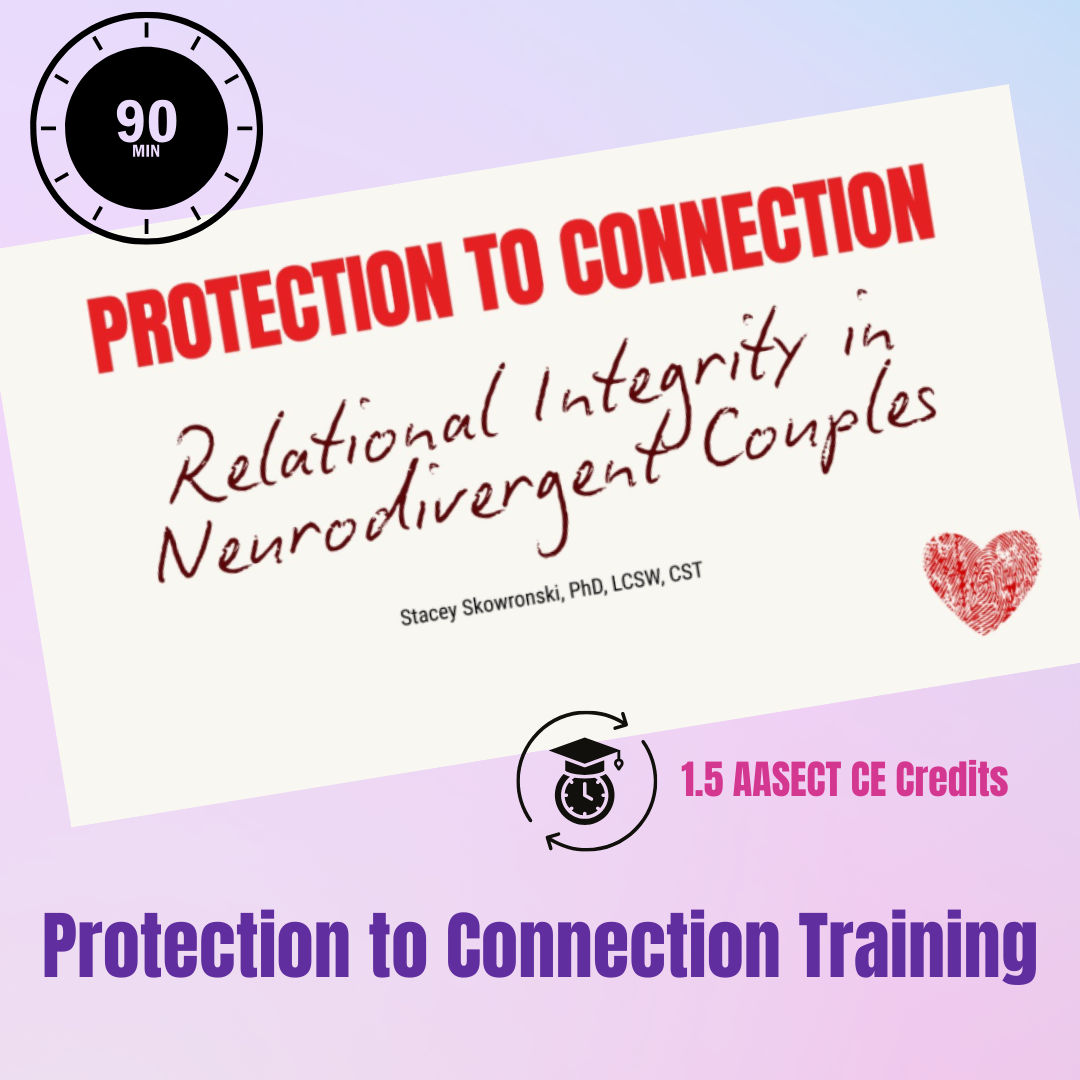
What you’ll get:
- 90-minute clinical training: From Protection to Connection: Relational Integrity in Neurodivergent Couples Work.
A structured, clinically applicable framework for understanding conflict as protection - and working with it in real time - 1.5 AASECT Continuing Education Credits (upon completion of post-test + evaluation)
- A Symbolic Emotional Tools video
- Relationship Rhythm & Integrity Pillars
- The Rhythms of Shared Connection Model
- Relational Integrity Sample Goals (for the therapist)
- Relational Integrity Couples Work Interventions (for the therapist)
✅ The Relational Integrity Framework
Learn how to assess and intervene across the four domains:
- Identity (dignity, non-pathologizing)
- Coherence (internal clarity, pacing)
- Relational Care (attunement, responsiveness)
- Accountability (repair without shame collapse)
✅ Protection → Connection Clinical Map
A step-by-step way to track:
- what each partner is protecting
- where capacity is breaking down
- how to intervene without forcing connection
✅ Real-Time Intervention Strategies
Concrete tools to:
- slow escalation
- restore internal clarity
- support co-regulation across difference
- guide repair without overwhelm
✅ Rhythm-Based Understanding of Couples
Learn how to translate differences in:
- regulation (how we stabilize)
- processing (how we reach clarity and meaning)
- expression (how our experience is communicated)
so they stop being misread as lack of care
✅ Misinterpretation Loop Framework
Identify and interrupt the cycle where:
difference → interpretation/meaning → emotional reaction → protection → misinterpretation/disconnection
✅ Clinical Language + Scripts
Use language that:
- reduces defensiveness
- validates both partners
- supports mutual understanding without collapsing into one side
✅ Integration of Major Clinical Frameworks
Includes applications of:
- Relational-cultural theory
- Neurodiversity paradigm
- Polyvagal theory
- Consent and anti-coersion based frameworks
- Differentiation + family systems
- Mentalization epistemic humility
Learning objectives
By the end of this training, participants will be able to:
- Conceptualize conflict in couples as protection rather than dysfunction, and identify what each partner is protecting under stress.
- Differentiate between relational differences and capacity (state), and explain how each contributes to misattunement and escalation.
- Apply the four domains of relational integrity (identity, coherence, relational care, accountability) to assess breakdowns in connection.
- Identify and interrupt the misinterpretation loop (difference → meaning → reaction → protection) that sustains relational conflict.
- Implement regulation- and pacing-based interventions that support co-regulation, consent, and repair without requiring self-abandonment or sameness.