A 12-Step Relationship Model for Finding Where You Are Stuck.
The Relational Integrity Skills Book
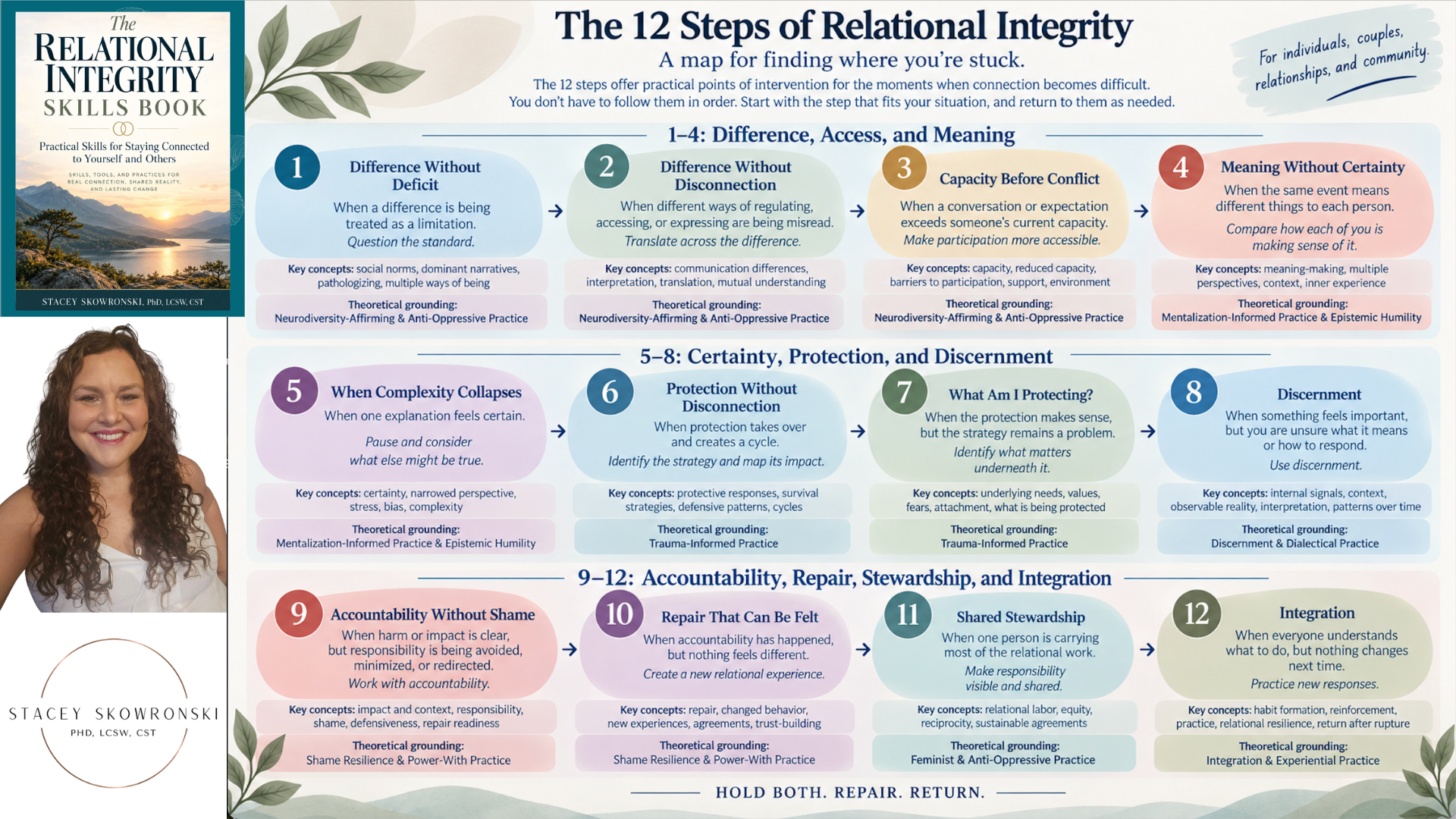
Understanding the pattern is the beginning.
Knowing what to do next is the skill.
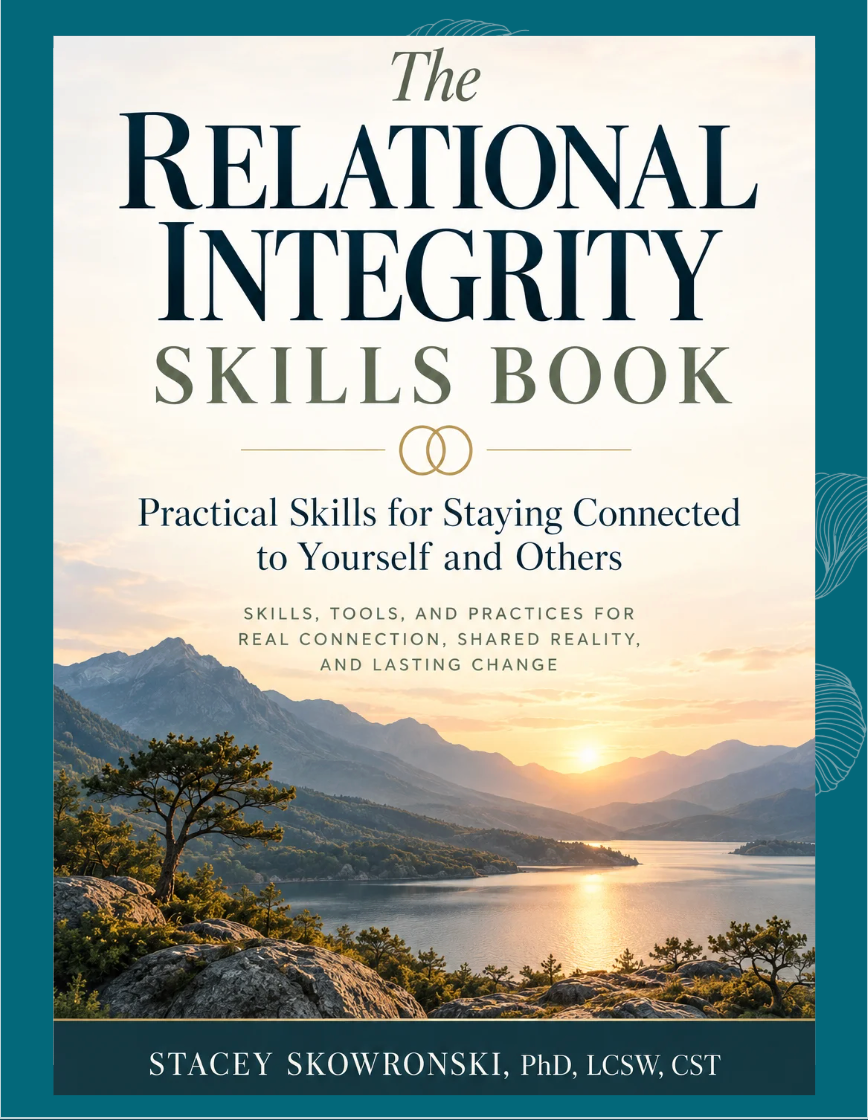
The Relational Integrity Skills Book
$99
For those who want to learn and apply the model independently.
-
Downloadable Skills Book PDF
-
Fillable Skills Book PDF
-
12 points of intervention to identify relational process stuck points
-
63 paired relational skills
-
13 skill-building chapters
-
Practical exercises, reflection prompts, and relationship tools for individuals, couples, and helping professionals.
-
A Skills Reference section to help you quickly identify relevant skills without needing to work through the book in order.
-
A structured, trauma-informed, and neurodivergent-affirming approach to moving from relational understanding toward practical skills, meaningful repair, and sustainable change.
The Skills Book and Group Learning
$129
For those who want a guided introduction to the framework
Includes everything in Option 1, plus:
-
A 90-minute live group psychoeducational session on December 18th at from 11 - 1230 pm CST
-
An overview of the 12-step model
-
Guidance on how to recognize where you're stuck and choose relevant skills
-
Time for questions
You may understand why a relational pattern keeps happening and still feel stuck when it happens again.
You might recognize that someone is overwhelmed, that a protective response has taken over, or that two people are experiencing the same interaction very differently.
But understanding why something happens does not always tell you what to do next.
The Relational Integrity Skills Book helps bridge the space between insight and practice. This structured, trauma-informed, and neurodivergent-affirming relationship model offers 12 practical points of intervention for moments when connection becomes difficult.
Rather than prescribing one correct way to communicate or relate, the model helps you:
-
Recognize what is happening,
-
Identify where the process is getting stuck,
-
Choose a skill that fits.
You do not have to follow the steps in order. You begin where you are stuck.
What Makes Relational Integrity Different?
At the heart of Relational Integrity are two commitments:
Coherence: Staying connected to yourself. Your experience, needs, limits, capacity, and dignity matter.
Connection: Remaining open to the other person. Their experience, needs, limits, capacity, and dignity matter too.
The work is learning how to hold both.
Relational Integrity does not ask people to abandon themselves to maintain connection.
It helps them develop greater awareness, access to choice, mutual understanding, and responsibility for how they participate.
The Four Ethical Guardrails of Relational Integrity
Understanding someone's experience is important. But understanding alone does not tell us whether a relational response is respectful, responsible, or sustainable.
Relational Integrity uses four ethical guardrails to help us stay oriented to what matters, especially when needs differ, emotions are high, or the next step is unclear.
✅ Dignity:
Both people's humanity and worth matter, even during disagreement, conflict, or rupture. Neither person has to surrender their dignity to maintain connection.
✅ Reciprocity:
Relational responsibility is shared in ways that respect both people's capacities, needs, and agreements. Contributions do not have to be identical or equal to be meaningful.
✅ Mutual Influence:
Both people's experiences, perspectives, and needs can genuinely inform what happens next. Connection is not built through compliance or one person's reality consistently overriding the other's.
✅ Shared Reality:
We make room for what happened, what each person experienced, the context surrounding it, and the impact that followed. Understanding remains open to new information rather than relying only on certainty or intention.
What You'll Learn:
Through 12 skill-building chapters and a final chapter on living Relational Integrity, you will learn to:
✅ Recognize when differences are being treated as deficits rather than understood.
✅ Translate different ways of regulating, communicating, processing, and expressing connection.
✅ Identify capacity barriers and make participation more accessible.
✅ Explore different meanings without assuming one interpretation is the whole truth.
✅ Recognize when stress narrows curiosity and complexity.
✅ Understand protective strategies, relational cycles, and their impact.
✅ Identify the needs, values, and concerns underneath protective responses.
✅ Use discernment to distinguish experience, interpretation, and observable reality.
✅ Practice accountability that considers both impact and context.
✅ Move toward repair through changed responses, supports, agreements, and new relational experiences.
✅ Make relational responsibility visible and develop sustainable agreements.
✅ Practice and integrate skills so that understanding can become something different over time.
You do not need to master all 12 steps.
The Skills Reference helps you find a place to begin, and the exercises help you practice from there.
Who is this for?
Individuals and Couples
For people who want to understand recurring relational patterns, navigate differences, strengthen communication, and develop more workable ways of relating.
The skills can support individual reflection or shared practice. Both people do not need to communicate, process, or participate in identical ways.
Therapists and Helping Professionals
For professionals looking for a structured, trauma-informed, and neurodivergent-affirming framework to help clients understand relational patterns and move from insight toward practical application.
The model offers a way to explore capacity, meaning, protection, accountability, repair, and shared stewardship while respecting differences in how people participate.
Relationships and Communities
Relational Integrity is not limited to romantic partnerships.
Its principles can also inform friendships, family relationships, professional relationships, and community interactions where difference, boundaries, responsibility, and mutual influence matter.
What's Included:
The Relational Integrity Skills Book:
Practical Skills for Staying Connected to Yourself and Others
You'll receive:
-
The complete Skills Book as a downloadable PDF.
-
A fillable PDF version for digital use.
-
Twelve chapters of paired relational skills, explanations, and exercises.
-
A final integration chapter, Living Relational Integrity.
-
A Skills Reference section to help you identify where you're stuck and choose relevant skills.
-
Practical tools for reflection, communication, accountability, repair, and shared stewardship.
The book is designed to be revisited. You can return to the skills that fit your circumstances rather than needing to complete every exercise in sequence.
Choose How You Want to Learn:
You Don't Have to Get It Right Every Time.
Relational Integrity is not about perfect communication, constant connection, or never becoming protective.
It is about developing the ability to recognize what is happening, understand what matters, consider impact and context, and find a workable way forward.
Sometimes that means communicating differently.
Sometimes it means pausing, adjusting expectations, setting a boundary, changing an agreement, or returning to repair.
And sometimes it means recognizing that connection and self-respect must both remain possible.
Hold Both. Repair. Return.